NBA First Basket Bets: complete UK scorer market system 2026
 Available in US
NBA First Basket Bets: A UK Bettor’s Complete Guide to the First Scorer Market
A UK bettor’s working guide to NBA first basket props — settlement rules, tipoff maths, value framework, variance reality and 2026 UK regulation.
The first time I lost a first basket bet on a technicality, I had Joel Embiid at 9/2 and watched him win the tip, hold at the elbow, get fouled hard on the drive, and sink two free throws. My ticket settled as a loser. The bloke next to me at the pub had backed Embiid for first scorer at shorter odds and won. Same player, same nine seconds, two outcomes. That gap is the entire reason this article exists.
An NBA first basket bet is a wager on which player scores the very first field goal. Not the first point — the first basket. Free throws do not count, and that single rule reshapes the maths underneath everything else. The first scorer market, which several UK books also offer, treats any point as the trigger and prices favourites at materially shorter odds because two free throws after an opening whistle still wins the bet. If you do not know which version sits on the slip, the price has no meaning.
UK bettors live with considerations the typical American guide skips. Our games tip well after midnight, the regulator has been reshaping promo rules through 2025 into 2026, books quote in fractional or decimal rather than American moneyline, and the operators holding genuine first basket markets — bet365, William Hill, Paddy Power, Sky Bet and BetMGM UK — each handle settlement edge cases differently.
First basket vs first scorer — the working definition
A first basket bet pays only if your player makes the first field goal of the game. A two-pointer or three-pointer from open play counts. Free throws never count. A first scorer bet pays on any point, including free throws — making the markets distinct in price and risk profile.
The UK NBA audience sits at roughly seven percent of internet adults — the smallest of the major NBA-watching nations but the most balanced in age and gender, and one overlapping heavily with the British prop-betting demographic. With the London Game now an annual fixture, UK first basket interest has shifted from curiosity to a steady weekly routine.
What follows is the framework I have refined across twelve seasons: how settlement works, where UK and US books diverge, how tipoff maths sets the floor of the prop, where value sits when it sits at all, and the variance you accept the moment you click confirm.
- Scorer Market Principles: Tipoff Probability and Value frameworks
- How the First Basket Market Actually Works
- Where UK Books Hold the Market
- Tipoff Mechanics: The Foundation Almost Everyone Skips
- Finding Value When the Market Forgets the Maths
- The Variance Reality and What It Demands of Your Bankroll
- Where UK Regulation Touches Your First Basket Account
- Why UK NBA Demand Is Quietly Reshaping the First Basket Market
- First Basket vs the Wider Family of Scoring Props
- A Pre-Tipoff Routine That Survives Real Money
- Questions UK Bettors Actually Ask About First Basket
- The Three Numbers to Carry Into Every Ticket
Scorer Market Principles: Tipoff Probability and Value frameworks
- A first basket bet pays only on the opening field goal — free throws never count, which is the single biggest source of confused settlements at UK books.
- Tipoff maths set the floor: the team that wins the opening jump scores the first basket roughly 64% of the time, so centre matchup precedes player price in any honest analysis.
- UK first basket markets sit on bet365, William Hill, Paddy Power, Sky Bet and BetMGM UK under UKGC rules, with 2025–26 reform — the £150 vulnerability check, 10x wagering cap, statutory levy — quietly reshaping how UK accounts experience promos.
- Even the strongest priced first basket option misses around 80–85% of the time, so a value framework — implied probability against player FB% against tip rate — matters more than picking favourites.
How the First Basket Market Actually Works
I once spent forty minutes explaining to a friend why his Jamal Murray ticket had not paid out, despite Murray scoring the opening points of a Nuggets game. Murray drew a shooting foul nineteen seconds in, banked both free throws, and on the next possession Aaron Gordon dunked. The bet lost. Murray’s points went on the board first; Gordon’s basket counted first. That is the mechanism the whole market hinges on.
Settlement triggers
A first basket bet settles the moment any player makes a field goal in regulation. The clock can read 11:58 or 0:01 of the first quarter — the rule is the same. Whichever player puts a made field goal on the scoreboard first, that ticket wins. Every other ticket loses, including any ticket on a player who scored via free throws beforehand.
Some UK books also offer a method market — first basket by two-pointer or three-pointer — and a few offer alternatives for the second quarter, second half, or fourth. These follow the same field-goal-only rule unless the slip says otherwise.
Free throws and the field-goal-only rule
The moment of greatest confusion is a shooting foul on the opening possession. Defender hand-checks the ball-handler, the ball-handler trots to the line, sinks both, and the inexperienced bettor watches their pick walk off with two points without resolving the bet. The market stays open. Whoever finishes the next live action with a made field goal takes it.
On first scorer markets, those free throws would have resolved the bet immediately. UK operators do not all describe this in identical language — always check the rules tab before staking.
| Market | Free throws count? | Settled when | Typical UK price band |
|---|---|---|---|
| First basket | No | First made field goal | 4/1 to 25/1 |
| First scorer | Yes | First point of any kind | 3/1 to 20/1 |
| First basket method (two-pointer) | No | First made two-point shot | 5/2 to 8/1 |
| First basket method (three-pointer) | No | First made three-pointer | 11/4 to 9/1 |
Market close at tipoff
UK books suspend the pre-match first basket market at scheduled tipoff and either close it or shift to a thinned-out in-play version. Most UK accounts see the pre-match price disappear at 0:00. The price is locked from the moment you confirmed.
The mechanical reason this matters: league-average team turnover percentage was 12.6% last season — roughly one in eight opening possessions ends without a shot attempt. A turnover sends the ball the other way, and your supposedly safe play on a tipoff-winning team’s primary scorer goes nowhere.
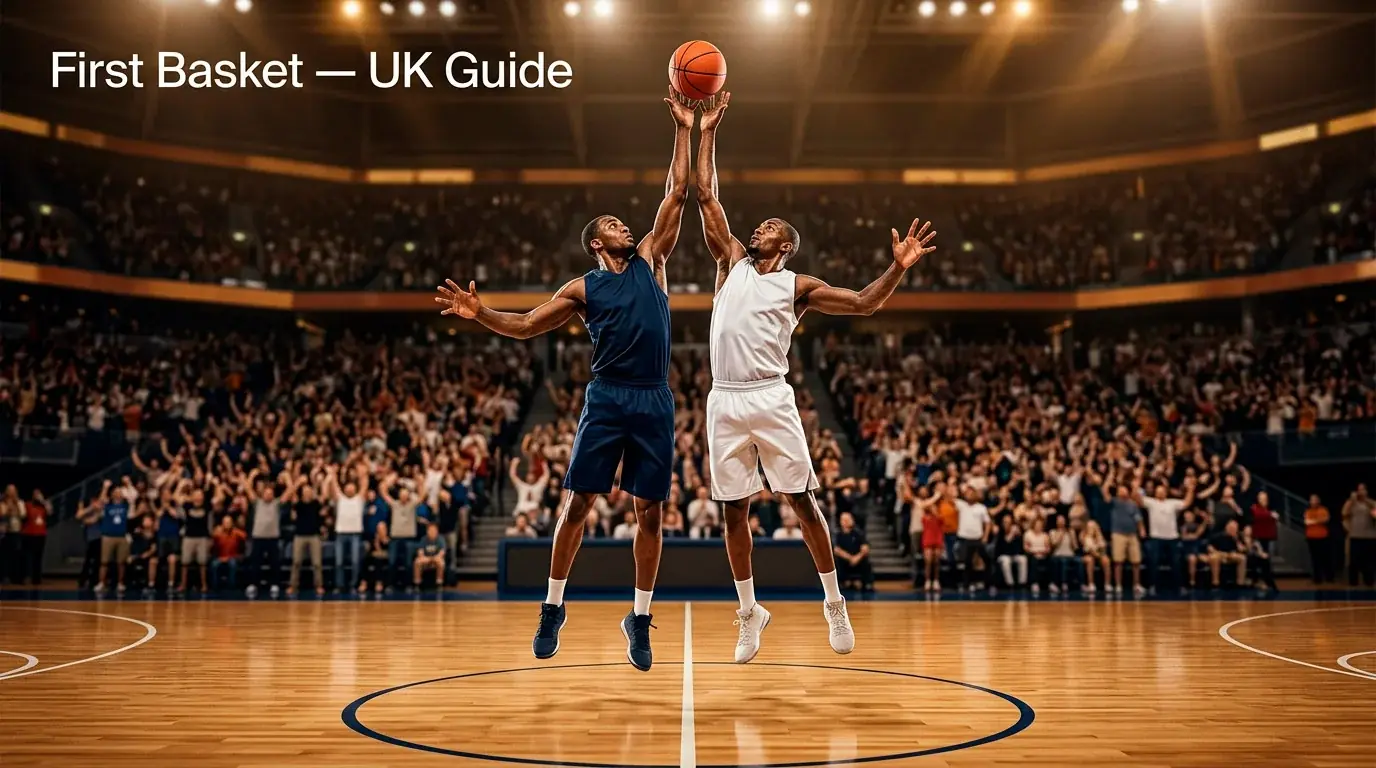
Tipoff — the jump ball at centre court that begins each game. The team gaining possession is said to have won the tipoff.
FB% — first basket percentage, the rate at which a given player has scored the very first field goal across his recorded starts. A 20% FB% means he has scored the opener in roughly one in five games started.
Three names anchored the most recent regular-season leaderboard with fifteen openers each — Anthony Edwards, Jamal Murray and Neemias Queta. Edwards attacks downhill on the first possession; Murray runs pick-and-roll into a mid-range jumper; Queta finishes lobs after winning the tip. Three roads to the same outcome.
Where UK Books Hold the Market
Walk into any independent bookmaker on a high street between Camden and Croydon and ask for a first basket bet on tonight’s NBA game. You will get a polite shrug and a redirect to the football coupon. The first basket prop is an online product in the UK, full stop, and the operators that hold it are the same handful that dominate online sports betting generally.
The UK sports betting market generates around £2.48 billion in annual gross gaming yield, sitting inside a remote casino, betting and bingo sector worth £7.8 billion, and a total UK gambling industry of £16.8 billion. NBA props are a sliver, but the sliver has fattened steadily across the past three seasons. The five operators worth knowing are below.
bet365
The deepest first basket market in UK terms, most regular-season games priced from late afternoon UK time. Player options run twelve to fifteen per side. Decimal and fractional toggle in account settings.
William Hill
Reliable pre-match pricing for marquee matchups and Sunday slates. Thinner field on weekday games. First scorer often listed alongside first basket — read the slip header.
Paddy Power
Aggressive promotional cycles around prop markets, particularly during NBA London Game weekend and playoffs. First basket pricing rounds generously on rank-and-file scorers.
Sky Bet
Strong basketball coverage overall, though first basket lists can be shorter. The interface treats the market as a sub-tab of player props rather than a top-line market.
BetMGM UK
Operates a first scorer model imported from its US parent, so free-throw rules read closer to the American template. Always verify whether you are looking at first basket or first scorer.
Standard UK first basket prices run from about 4/1 on a primary scorer at home with a high-conviction tip win, out to 20/1 or 25/1 on a wing player who occasionally takes the opening shot. The shape is a long tail — three or four players with realistic claims, then low-probability options padding the slip.
Sample line — Jalen Brunson first basket at 6/1 the morning of a Knicks home game. Implied probability 14.3%. Brunson’s recorded first-basket rate over the prior 80 starts was 21.2%. The gap between price and rate is what value-spotting looks like.
The American convention of quoting first basket prices in moneyline format does not exist on UK accounts by default. UK books quote fractional or decimal, and the toggle changes the display. The maths is unchanged: 6/1 equals 7.00 equals +600, all implying roughly 14.29%.
Where books diverge is on edge-case settlement and on how aggressively each moves price as tipoff approaches. A working comparison of how UK bookmakers compare on first basket markets — including the specific settlement language each uses on edge cases — sits in a separate guide. For pillar purposes: all five have the market, pricing is broadly similar within ten to twenty percent on most names, and price-shopping is worth your time.
One regulatory note: any UK account that reaches £150 of net spend over a rolling 30 days sits within the financial vulnerability check threshold the regulator has operated since early 2025. UK first basket activity exists inside a watched envelope, even at modest stakes.
Tipoff Mechanics: The Foundation Almost Everyone Skips
Ask ten casual NBA bettors what determines the first basket and seven will name a player — Wembanyama for height, Brunson for usage, Embiid for offensive gravity. Almost nobody starts with the centre matchup at the jump circle. That is a shame, because researchers ran the regression on roughly thirteen million play-by-play events and found something that should anchor every first basket ticket placed.
64%
First basket conversion after a won tipoff
52.8%
Game win rate for the tipoff-winning team
5.6 p.p.
Win-probability bump from winning the tip
12.6%
League-average team turnover percentage
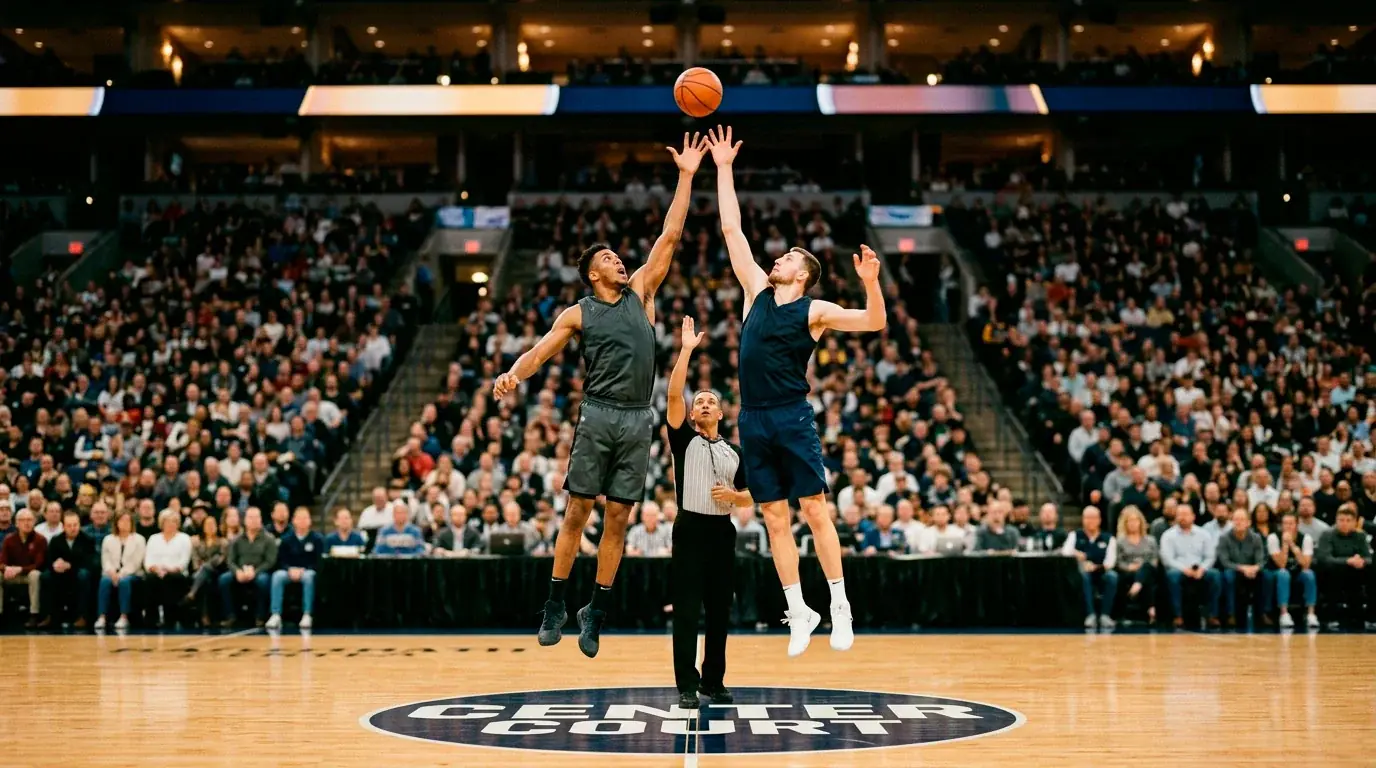
The 64% rule from Dickinson regression
The Dickinson College team set out to test whether the tipoff was statistically meaningful or effectively a coin flip. The regression controlled for team strength, home court advantage, and a stack of confounders any sceptic would reasonably demand. The headline: when a team won the tipoff, it scored the very first basket on 64% of occasions.
The season-long impact on win probability is modest — 5.6 percentage points, with tipoff-winning teams winning 52.8% of games against a baseline near 47%. Modest at the game level. Anything but modest at the first basket level, where the entire wager resolves inside ninety seconds. The weight of a single chance event at the start is small relative to the rest of the game, but the analysis captures the cascading effect of who controls the ball first.
Centre matchup as a leading indicator
If you remember one thing: the centre matchup is the leading indicator, and the player price is the trailing one. UK books quote the player. Smart UK bettors quote the jump.
The two starting centres are doing one job — gaining possession. The taller wins more often, but timing, vertical leap, and reaction speed are not strictly correlated with height. There are seven-footers who lose tipoffs at a 40% clip and six-foot-eleven big men winning at over 60%. Last season the Lakers won 61.3% of their opening tipoffs while Brooklyn won only 36.5% — a 25-point swing between two franchises in the same league.
That split shows up twice a week somewhere on the schedule, and the books only sometimes price it in. When two teams at the extremes meet, the dominant team’s primary scorer is materially more likely to score first than his price suggests. When two below-average tip teams meet, the rational play is often no play.
Translating the numbers into a prop estimate
A primary scorer on a 60% tipoff team faces a different baseline than the same calibre player on a 40% tipoff team.
Step 1: Home team tipoff win rate — 60%.
Step 2: Conditional first-basket conversion on a won tip — 64%.
Step 3: Home team first-basket probability — 0.60 × 0.64 + 0.40 × 0.36 ≈ 52.8%.
Step 4: Player share — if the primary scorer takes 28% of first shots, 0.528 × 0.28 ≈ 14.8%.
Step 5: At 6/1 implied probability is 14.3%. Barely covers. At 7/1 it is meaningful value.
This is the floor of an honest first basket model. Usage rates, defensive matchups, foul trouble history, and recent form all stack on top. The fuller treatment sits in the dedicated tipoff statistics breakdown. For pillar purposes: 64% conversion on the won tip, 25-point team-level swings, and a centre matchup almost nobody bothers to check.
Finding Value When the Market Forgets the Maths
Value gets thrown around in betting content the way “vintage” gets thrown around in fashion — often, loudly, frequently with no meaning attached. On first basket props it has a precise definition: the implied probability of the price you are taking is lower than your honest estimate of the player’s true probability of scoring first. Everything else here is mechanism for getting to that comparison.
Team tipoff win rate, the player’s share of his side’s first shots, and his first basket percentage. Feed those in and the model builds a probability from the ground up, holds it against the price you have been offered, and tells you the minimum price worth taking.
How it works. A team that wins the opening tip scores the first basket around 64 per cent of the time, and around 36 per cent of the time when it loses the tip, which turns a tipoff win rate into a team first-basket probability. Multiply that by the player’s share of his side’s first shots and you have the structural estimate. His own first basket percentage is the stabiliser, and the slider decides how the two are weighted. Implied probability is one divided by the decimal price. More in the guides to tipoff statistics and calculating FB percentage.
Estimates only. Remember the settlement rule: free throws never count, only the first made field goal. Even your best ideas lose four tickets in five. 18+ — please gamble responsibly. Free, confidential support at BeGambleAware.
Implied probability decoded
A fractional price of 6/1 implies a probability of 1 / (6+1), or 14.29%. A decimal of 7.00 gives the same number. UK books bake an overround into the full market, so implied probabilities across the card sum to 110% to 118% — where the bookmaker's margin sits. The practical consequence: a "fair" first basket price is roughly 10–15% longer than the one you see. That is the headwind every first basket bettor walks into.

Cross-checking against FB%
The single most useful number on a first basket card is not the price; it is the player's recent FB% across current-season starts. Two examples make the point.
Victor Wembanyama posted a 20.7% first basket rate across 58 starts. The Spurs won the opening tip 77.0% of the time during that window, and Wembanyama took 27.6% of his team's first shots. The model produces a probability close to 20%. The market price sat between 4/1 and 9/2, implying 18% to 20%. Right on the line. No edge.
Jalen Brunson's 21.2% FB% across 80 starts is more interesting. Brunson took 23.8% of the Knicks' first shots, and New York won the opening tip at 53.4%, converting to a 61.4% team first-basket rate. When Brunson was priced at 6/1 — 14.3% implied — the gap was nearly seven points. That is what genuine value looks like. At 9/2 the gap closed to two points. Same player, only one price worth taking.
The implied probability versus FB% comparison
Player: Brunson. Posted price: 6/1.
Step 1: Implied probability — 1 / (6+1) = 14.29%.
Step 2: Player FB% — 21.2%.
Step 3: Matchup adjustment — Knicks home, opponent at 50% tips. Modest upward to 22%.
Step 4: Compare — model 22% vs implied 14.3%. Edge of 7.7 points.
Step 5: Value confirmed.
Stacking tip plus first-shot usage
The cleanest framework layers three numbers: team tipoff win rate, player share of first shots, and player season FB%. The first two are leading indicators, the third is the stabiliser. When all three line up and the market implies materially less than the model, that is a value play.
The three-number filter
Before placing any first basket ticket, write down three numbers next to the player's name: the team's tipoff win rate this season, the player's percentage of his team's first shots, and the player's FB% across recent starts. If you cannot find current values for all three, you are betting on vibes.
What does not work is reverse-engineering. Do not start from the price and hunt for reasons to take it. Start from the data, build the estimate, and only then look at the price. The brain is too willing to invent justification for a number it has already seen.
Three filters that save more than they cost: skip games featuring two below-average tip teams, skip games where the primary scorer's FB% has fallen meaningfully in the last ten starts, and skip games where the line moves more than 25% in the final two hours before tipoff because that movement usually reflects information you do not have. The discipline is to walk away when none of those filters comes up clean. Selectivity is half the edge in this market.
The Variance Reality and What It Demands of Your Bankroll
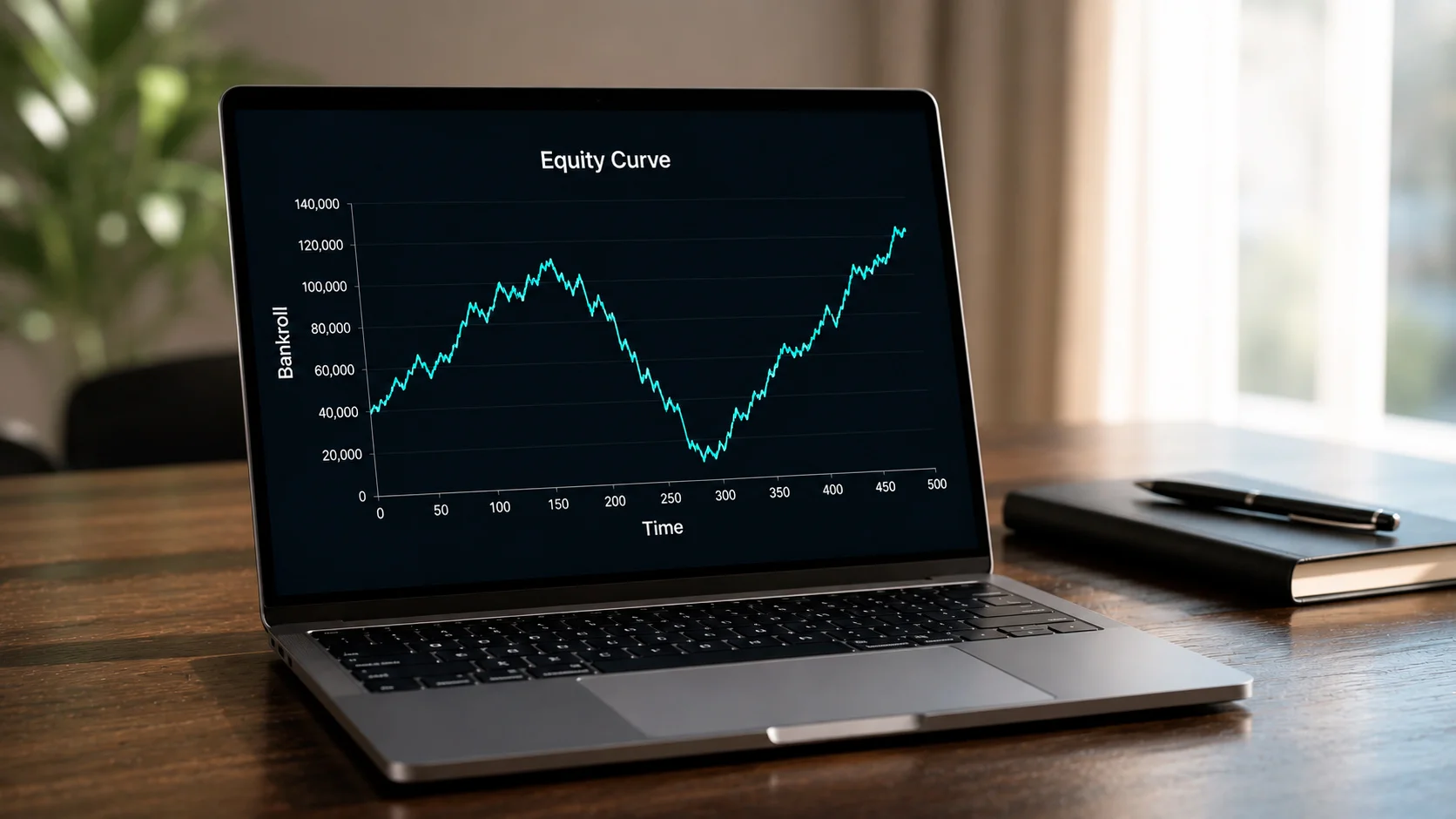
Here is a number that should change how you think about this market. Even the most likely first basket scorer in any game converts at under 20%, and a player priced at 15% implied will miss roughly 85% of attempts. First basket ranks among the highest-variance props in basketball, with razor-thin margins even when the maths is on your side.
Why even favourites miss
The market is structurally cruel to favourites because the conditions for any single player to score the opener are stacked. He has to start; his team has to win or lose the tip in a way that gets him an early touch; he has to take a shot; the shot has to fall. Each has probability less than one, and multiplying four sub-one probabilities always yields something smaller. A 75% tipoff team plus 28% first-shot usage plus 50% effective field-goal percentage on early shots produces roughly 11% individual conversion. The 20% stars are the structural ceiling, not the floor.

That ceiling sets a hard lower bound on how often you collect. If your model identifies a player at 22% true probability and you take him at 6/1, you still lose 78% of tickets. Zero wins from ten 6/1 tickets is roughly an 8.8% event — uncommon but far from impossible. Variance is the cost of admission, not a sign something has gone wrong.
85%
The miss rate on a player priced at 15% implied probability — the typical short-end first basket favourite. Variance is not a tail risk in this market; variance is the market.
Staking sizing for high-variance props
If you accept 80% miss rates as baseline, the staking question becomes a bankroll-survival question, not a return-maximisation question. Flat staking is fine in lower-variance markets and dangerous here because it ignores the bunching of losses. Percentage staking shrinks your stake automatically during drawdowns.
UK gambling literature settles on 2–3% of bankroll as the sensible upper bound for high-variance props. On a £500 bankroll that is £10 to £15 per ticket. The numbers feel small to anyone used to football accumulators where 5% stakes are common. Deliberately small.
Do
- Cap any single first basket stake at 2–3% of current bankroll.
- Reduce stake size after three consecutive losses, not increase it.
- Track every ticket — price, model probability, outcome — across a full season before judging your process.
- Treat first basket as the high-variance corner of your activity, not the centrepiece.
Do not
- Chase losses by doubling stakes after a cold run.
- Combine multiple first basket selections into a same-game accumulator without understanding the correlation.
- Bet first basket every night — selectivity is half the edge.
- Let a hot streak convince you the variance is gone. It is not.
A 2–3% staking discipline is the price you pay for absorbing the bunching of losses without the bankroll evaporating. The dedicated guide to first basket variance and bankroll strategy covers fractional Kelly, drawdown mathematics and session limits in depth. For pillar purposes: 80% miss rates, 2–3% maximum stake, season-long timeframe before judging anything.
Where UK Regulation Touches Your First Basket Account
A Tuesday morning in March, my phone buzzed with an email from a UK book asking me to confirm my source of funds. I had not deposited anything unusual. I had simply crossed a rolling-30-day net spend threshold across multiple sports, and the system flagged the account in line with the regulator's framework. That experience is now standard for any UK bettor with regular activity.
Great Britain hosts the largest regulated online gambling market in the world, with sector gross value north of £15 billion and roughly 22.5 million adults engaging on a regular basis. UK adult online gambling participation sits at 39%, and roughly 290 million online bets on real events are placed monthly. The first basket prop is a tiny slice, but the regulatory rules apply identically.
UKGC heads-up
UK gambling reform from 2025 into 2026 has reshaped three things that affect prop bettors directly: the £150 net spend trigger for financial vulnerability checks, the 10x maximum wagering requirement on promotional bonuses, and a statutory levy that has redirected operator funding into harm-reduction programmes.
Since 28 February 2025, UK remote operators must undertake financial vulnerability checks once net spend exceeds £150 over a rolling 30-day period. Net spend means deposits minus withdrawals, not stake volume — a bettor depositing £200 and withdrawing £80 has net spend of £120 and stays below threshold. The check is light-touch — open-source data review, public records — but can escalate to source-of-funds documentation. The regulator has framed this as needing to balance protecting people from potentially life-ruining harm with respecting the freedom of adults to make their own choices.
From 19 January 2026, UK gambling promotions are capped at a maximum 10x wagering requirement, and bonuses combining different gambling products are prohibited. The practical impact on first basket bettors is mostly on free-bet structures: a £20 free bet that previously came with a 25x rollover legally cannot exceed 10x. That makes promotional bonuses materially more usable — and materially rarer.
The statutory gambling levy introduced in April 2025 redirects an estimated £100 million of operator-derived funding into harm reduction, research and treatment, replacing the previous voluntary contribution.
What to verify before you place a UK first basket ticket
- Account is in good standing and not flagged for review.
- Rolling 30-day net spend sits below the £150 vulnerability threshold, or you are prepared for a check.
- Any promotional bonus attaches to a 10x or lower wagering requirement.
- Deposit and withdrawal limits are configured to your actual budget, not your aspirational one.
- A session-loss limit is set in account settings.
None of this should put a UK reader off the market. The regulated UK environment is one of the safer places in the world to place a first basket bet specifically because of the friction the regulator has built in — and the regulator's own framing on the broader landscape is that there is nothing more exploitative than the unregulated alternative. A fuller treatment of UK gambling regulation as it touches NBA prop betting walks through every reform date and threshold.
Why UK NBA Demand Is Quietly Reshaping the First Basket Market
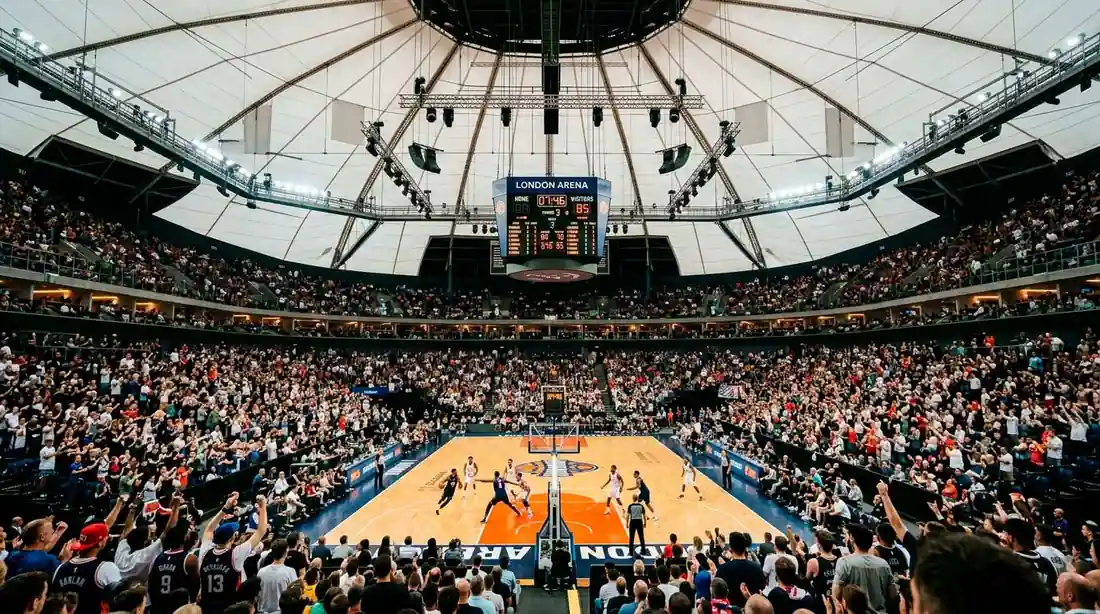
The O2 was rocking the night Memphis beat Orlando 126–109 in front of more than 18,000 fans, and what struck me was not the score — it was the timestamps on my phone after the final buzzer. Group chats from friends who had never bet basketball in their lives, asking which book to use for next year's London Game. The 18 January 2026 fixture was the 19th NBA game in the UK since 1993 and the broadcast became the most-watched NBA Global Game ever in the UK.
7%
UK internet adults watching NBA games — the smallest of six surveyed markets, but with a uniquely concentrated demographic profile.
57%
Share of UK NBA viewers under 35 — the highest among the six markets analysed.
13th
Basketball's rank in the EY-Parthenon Sports Engagement Index after a seven-place jump, and 6th among UK Gen-Z adults aged 18–24.
+40%
Sky Sports NBA viewership growth since 2019, with viewers under 30 driving the bulk of the increase.
The UK NBA viewer is younger than the UK football viewer, more evenly split by gender at 52% male and 48% female, and far more likely to engage through digital channels — Sky Sports and Prime Video rather than terrestrial broadcast. The first exclusive Amazon Prime Video NBA Cup final in December averaged 3.07 million viewers, and global NBA consumption topped 1.3 billion hours last season — a 93% year-on-year increase.
The reason this matters for first basket markets is engagement frequency. A casual football bettor placing a bet a week is fundamentally different from a Gen-Z NBA fan placing a prop or two every other game night, and the latter is now a meaningful share of UK first basket volume. The growth pattern is driven by digital content and live experiences.
The 2026 London Game was the 19th NBA fixture played in the UK since the league first brought regular-season basketball to British soil in 1993. The first took place at Wembley Arena; subsequent games have rotated through The O2, with the basketball setup now treated as a permanent fixture.
Time zone is the structural quirk that reshapes UK first basket behaviour. Most NBA games tip off between midnight and 4am UK time, which means the UK bettor is either watching live in the small hours or skipping live coverage and placing pre-match tickets earlier in the evening. In-play first basket markets — which represented 62.35% of broader online sports betting market share in 2025 — exist for UK accounts but require staying up. Pre-match first basket pricing is therefore disproportionately the UK product.
The UK Government and NBA jointly committed approximately £10 million to grassroots basketball facilities, and the league has signalled — in the words of NBA Europe and Middle East leadership — that the O2 is a world-class arena and London a massive sporting destination, meaning the league fully intends to keep returning. A deeper read on how UK NBA fandom and the London Game cycle reshape the first basket market sits separately.
First Basket vs the Wider Family of Scoring Props
Most casual NBA bettors I know lump every "first" or "anytime" prop into a single bucket and pick whichever has the prettiest odds. That is a quick way to compound losses, because these markets are not interchangeable — they have meaningfully different settlement mechanics, price structures and risk profiles.
| Market | How it settles | Typical UK price | Risk profile |
|---|---|---|---|
| First basket | First made field goal of the game | 4/1 to 25/1 | Highest variance — single binary event in opening seconds |
| Anytime scorer | Player scores at any point in the match | 1/3 to 4/1 | Lowest variance — long resolution window, low price |
| Last basket | Final made field goal before the buzzer | 5/1 to 20/1 | High variance — affected by score margin and intentional fouling |
| First three-pointer | First made shot from beyond the arc | 6/1 to 30/1 | Highest variance — depends on team and player shot selection |
| Second-half first basket | First field goal after halftime | 4/1 to 20/1 | High variance — opening-half strategy resets influence usage |
The anytime scorer market is the workhorse of NBA prop betting and the natural starting point for anyone new to the category. Forty-two minutes of basketball gives a primary scorer roughly a 95% chance of putting up at least two points, which is why the price is short. Low variance, high predictability, modest entertainment value.
Last basket carries its own quirks because end-of-game situations distort scoring patterns. A team trailing by four with twenty seconds left intentionally fouls, sending the leading team to the line and shifting last-basket probability away from the trailing team's natural scorers. The rules-of-thumb that work for first basket do not transfer.
The first three-pointer market is, in some matchups, sharper than the headline first basket market because the field of plausible candidates is narrower. Roughly half the players on a typical roster do not regularly attempt threes in the opening minutes, which collapses the candidate pool.
Second-half first basket behaves differently because the alternating-possession arrow comes into play — whichever team did not get the opening tip starts the third quarter with possession, removing the centre-matchup edge that drives the first-half market.
The NBA's partnership with FanDuel from 2024 onward has unlocked real-time player-tracking data, enabling micro-bet types like "next player to score" and "total points in the next two minutes." These exist in nascent form on a couple of UK accounts and are likely to expand.
The market comparison is the map; the pre-tipoff routine is the territory.
A Pre-Tipoff Routine That Survives Real Money
I keep a printed sheet next to my laptop on game nights. Unglamorous and a little embarrassing, but it has cost me far less money over the seasons than the "I just have a feeling" approach used to. The list is short on purpose — six checks, none over thirty seconds, all of which compound into a process that filters out the worst tickets before they hit a slip.
The six-step pre-tipoff routine
- Check the home team's tipoff win rate this season. Anything below 45% means pause before backing a player on that side — team-level splits run as wide as 60% versus 40% across the league.
- Confirm the starting centre. A late substitution at centre — injury, rest, foul trouble in a back-to-back — can shift the team's tipoff win rate by 10–15 percentage points.
- Read the opening-possession script. The first set play after a won tip is usually predictable from recent tape, and tells you which player is most likely to take the first shot.
- Compare the price across at least three UK books. The spread on the same player can run from 5/1 to 7/1 on identical evening cards — that gap is the difference between value and no value.
- Lock stake size as a fixed percentage of current bankroll, not starting bankroll. After three losses your stake should be smaller; after three wins it stays the same. Asymmetric on purpose.
- Check your account's net spend across the rolling 30 days. If you are near the £150 vulnerability threshold, factor that in before placing the ticket.
The routine is not designed to find winners. It is designed to filter out tickets that, on cold review, you would not have placed in the first place. A bad ticket avoided is mathematically equivalent to a winning ticket cashed at the same odds, and over a season the avoidance discipline does more for the bankroll than selection discipline.
The checklist gets you to a clean ticket. The questions below cover what tends to come up after the ticket is placed.
Questions UK Bettors Actually Ask About First Basket
These come from twelve seasons of conversations — pub chats, message-board threads, emails from readers burned by an obscure rule.

What is an NBA first basket bet and how does it work?
It is a wager on which player scores the first field goal of the match — the first made two- or three-pointer. Free throws do not count. The market opens hours before tipoff and closes at the jump ball. Pricing runs from about 4/1 on a strong primary scorer to 25/1 on rotational players. Even the most likely scorer wins under 20% of the time, so the market rewards process over instinct.
Do free throws count as the first basket?
No. If a player draws a shooting foul on the opening possession and sinks both free throws, the points hit the scoreboard but the market stays open until someone makes a field goal. This is the biggest mechanical difference between first basket and first scorer markets, and the most common source of confused settlements at UK books.
How do you find value on NBA first basket props?
Compare the implied probability of the offered price against your honest estimate of the player's true probability. Implied probability equals 1 divided by (fractional odds plus 1) — so 6/1 implies 14.3%. Build your estimate from three numbers: the team's tipoff win rate, the player's share of his team's first shots, and his recorded first-basket percentage across the current season. When the model probability beats implied probability by five points or more, the price has value.
Which UK bookmakers offer NBA first basket markets?
Five UKGC-licensed operators reliably list the market: bet365, William Hill, Paddy Power, Sky Bet and BetMGM UK. bet365 typically lists the deepest field. Paddy Power runs aggressive promotional cycles around the London Game and playoffs. Sky Bet and William Hill cover marquee matchups but list shorter player fields midweek. BetMGM UK uses a first-scorer settlement template imported from its US parent — verify the slip header on every ticket.
What is the difference between first basket and first scorer bets?
First basket settles only on a made field goal. First scorer settles on the first point of any kind, including free throws. The difference matters most on the opening possession: if a player draws a shooting foul nineteen seconds in and sinks both free throws, a first scorer ticket on him wins, while a first basket ticket on the same player remains live. First scorer prices on the same favourite are typically 10–15% shorter.
How important is the tip-off when betting first basket?
It is the single biggest leading indicator. Regression on roughly 13 million play-by-play events found that the team winning the opening tipoff scored the first basket 64% of the time. Team-level tipoff win rates run from below 40% to above 60% — a 20-point swing. Any first basket ticket placed without checking that number is a price taken on faith.
Is NBA first basket betting legal in the UK?
Yes, at any UK Gambling Commission-licensed operator. The UK regulator oversees the largest regulated online gambling market in the world, with sector gross value north of £15 billion and roughly 22.5 million adults engaging on a regular basis. Bettors must be 18 or over and are subject to the standard framework — including the financial vulnerability check threshold of £150 net spend over a rolling 30-day period.
The Three Numbers to Carry Into Every Ticket
If you take nothing else from this guide, take three numbers: 64%, 21%, and 2%. The first is the rate at which the tipoff-winning team scores the first basket — the foundation of every honest model. The second is the approximate ceiling for any individual player's first basket percentage in any reasonable sample — even Wembanyama and Brunson sit just above 20%, meaning even your best ideas should win roughly one in five tickets. The third is the upper bound on what you should risk on any single ticket as a percentage of bankroll — the price you pay for absorbing variance without the bankroll evaporating in a bad month.
The framework is mechanical: build the model from team tipoff win rate, player first-shot share, and player FB% before looking at the price; calculate implied probability as one divided by fractional plus one; place the ticket only when the gap is meaningfully positive; stake no more than 2–3% of current bankroll. None of those steps is glamorous. All of them compound.
The market rewards process discipline at the rate of fractions of a percent per ticket, compounded across hundreds of tickets across a full season. The bettor treating it as a weekend lottery loses to the bettor treating it as a slow accumulation of small edges. The data is publicly available; the discipline is not.
The market will keep evolving. UKGC reform continues, the NBA's data partnerships are expanding into micro-bet territories that did not exist three seasons ago, and the UK audience is younger and more engaged with each fixture. None of that changes the underlying maths. The tipoff still matters, the player still has to take and make the shot, and variance still rules the season. The bettor who internalises that, and applies the framework with discipline, will arrive at the end of a UK NBA season with a clearer head — and across enough tickets, a meaningfully better record.
Created by the ”nba First Basket Bets” editorial team.